
R D Sharma Solutions Class 10th Ch 3 Pair Of Linear Equations In Two Variables Exercise 3 3
2 x − 5 y ≥ − 10 2 x − 5 y − 2 x ≥ − 10 − 2 x − 5 y ≥ − 2 x − 10 − 5 y − 5 ≤ − 2 x − 10 − 5 R e v e r s e t h e i n e q u a l i t y y ≤ 2 5 x 2 In slopeintercept form, you can see that the region below the boundary line should be shaded513 Evaluate a double integral over a rectangular region by writing it as an iterated integral;
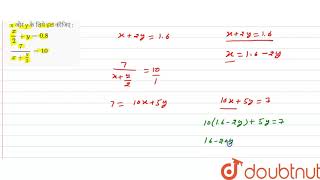
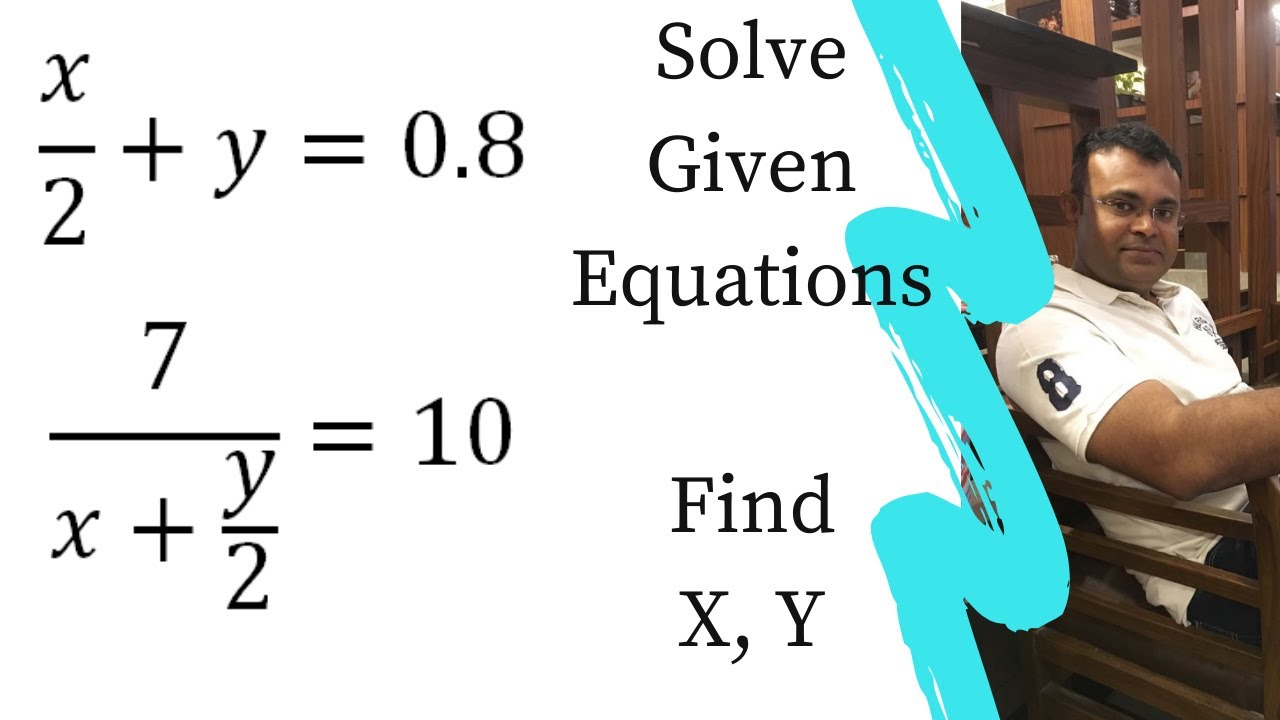
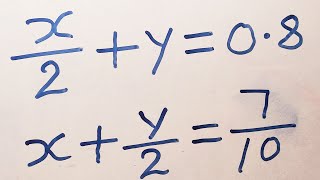
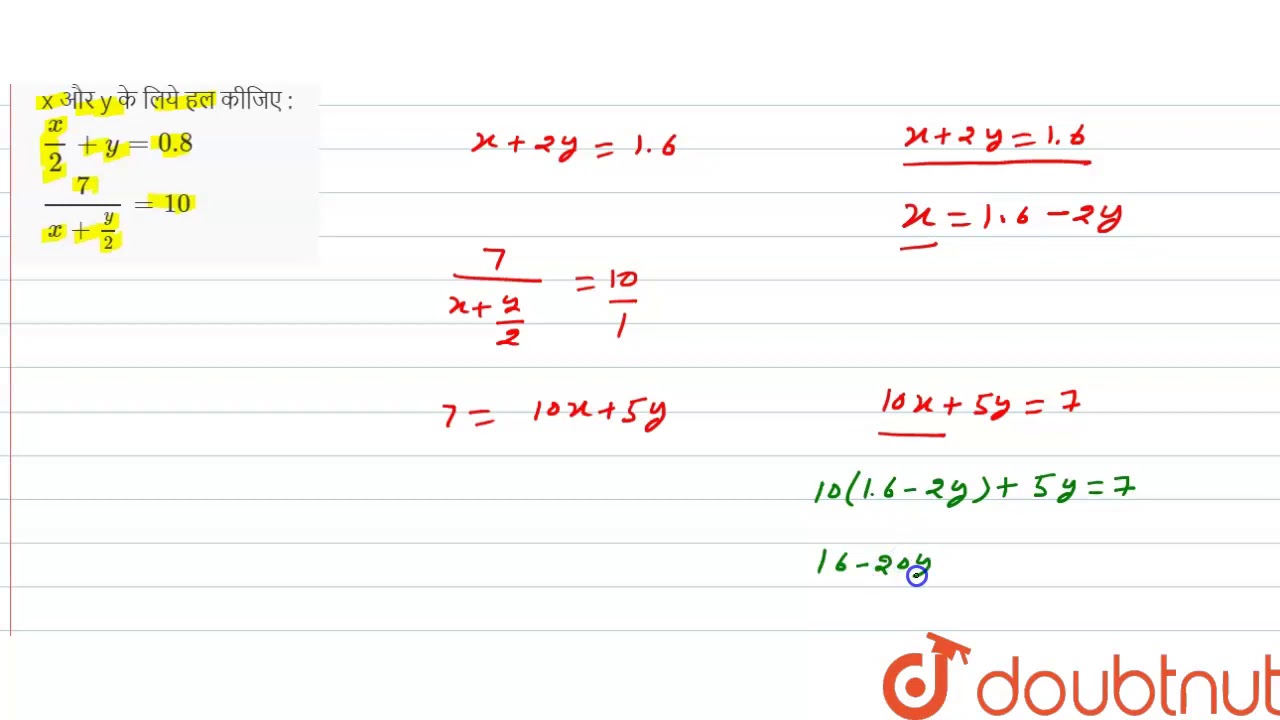
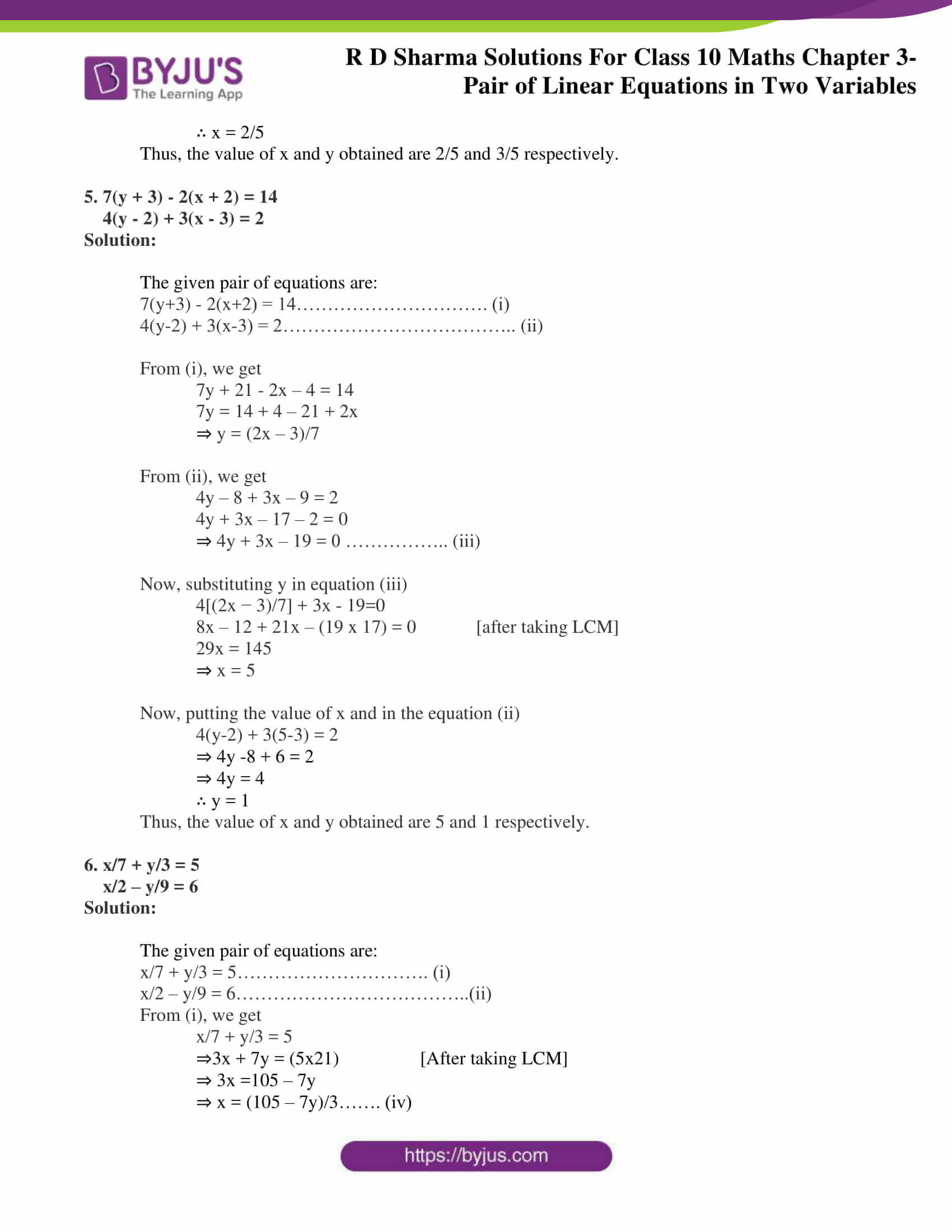
X/2 y=0.8 7/x y/2=10 by elimination method
X/2 y=0.8 7/x y/2=10 by elimination method- This method is known as the Gaussian elimination method Example 2 Solve the following pair of simultaneous linear equations Equation 1 2x 3y = 8 Equation 2 3x 2y = 7 Step 1 Multiply each equation by a suitable number so that0 y 8 < Z1 0 x2dx 9 =;

Pair Of Linear Equations In Two Variables Class 10 Solutions Exercise 3 3
X2 y = x2 {z} g(x) 1 y {z} f(y) 2 Separate the variables y dy = x2 dx 3 Integrate both sides Z y dy = Z x2 dx y2 2 = x3 3 C 0 4 Solve for y y2 2 = x3 3 C 0 y2 = 2x3 3 C y = r 2x3 3 C Note that we get two possible solutions from the If we didn't have an initial condition, then we would leave the 2in the nal answer, or weEduRev Class 10 Question is disucussed on Solving Systems Of Equations By Elimination Method Step I Let the two equations obtained be a 1 x b 1 y c 1 = 0 (1) a 2 x b 2 y c 2 = 0 (2) Step II Multiplying the given equation so as to make the coefficients of the variable to be eliminated equal Step III Add or subtract the equations so obtained in Step II, as the terms having the same coefficients may be
Answer (1 of 3) (a) 2x 3y = 12(i) and x y = 1(ii) (ii)×3 ==> 3x 3y = 3(iii) Now we can eliminate y by adding (i) & (iii) (i) (iii) ==> 5xF(x) = 0 (Figure1) 1 Similarly we can get a marginal distribution for YHomogeneous Differential Equations A first order Differential Equation is Homogeneous when it can be in this form dy dx = F ( y x ) We can solve it using Separation of Variables but first we create a new variable v = y x v = y x which is also y = vx And dy dx =
X/2 y=0.8 7/x y/2=10 by elimination methodのギャラリー
各画像をクリックすると、ダウンロードまたは拡大表示できます
 |  |  |
 |  | |
 | ||
「X/2 y=0.8 7/x y/2=10 by elimination method」の画像ギャラリー、詳細は各画像をクリックしてください。
 | ||
 |  |  |
 |  |  |
「X/2 y=0.8 7/x y/2=10 by elimination method」の画像ギャラリー、詳細は各画像をクリックしてください。
 |  | |
 |  | |
 | | |
「X/2 y=0.8 7/x y/2=10 by elimination method」の画像ギャラリー、詳細は各画像をクリックしてください。
 |  |  |
 |  |  |
 |  |  |
「X/2 y=0.8 7/x y/2=10 by elimination method」の画像ギャラリー、詳細は各画像をクリックしてください。
 |  |  |
 |  |  |
 |  |  |
「X/2 y=0.8 7/x y/2=10 by elimination method」の画像ギャラリー、詳細は各画像をクリックしてください。
 |  | |
|  |  |
 |  | |
「X/2 y=0.8 7/x y/2=10 by elimination method」の画像ギャラリー、詳細は各画像をクリックしてください。
 |  | |
 |  | |
 |  |  |
「X/2 y=0.8 7/x y/2=10 by elimination method」の画像ギャラリー、詳細は各画像をクリックしてください。
 |  | |
 |  | |
 |  | |
「X/2 y=0.8 7/x y/2=10 by elimination method」の画像ギャラリー、詳細は各画像をクリックしてください。
 |  | |
 |  | |
 |  | |
「X/2 y=0.8 7/x y/2=10 by elimination method」の画像ギャラリー、詳細は各画像をクリックしてください。
 |  | |
 |  |  |
 | ||
「X/2 y=0.8 7/x y/2=10 by elimination method」の画像ギャラリー、詳細は各画像をクリックしてください。
 |  | |
 |  |  |
 |  | |
「X/2 y=0.8 7/x y/2=10 by elimination method」の画像ギャラリー、詳細は各画像をクリックしてください。
 |
For example, 0≠8, 2≠0, etc In such cases, we cannot eliminate only one variable Both the variables get eliminated For example, let us solve two equations 2xy=4 __ (1) and 4x2y=7 __ (2) by the elimination method In order to make the x coefficients equal in both the equations, we multiply equation (1) by 2 and equation (2) by 1The steps for the elimination method are outlined in the following example Example 1 Solve by elimination {2 x y = 7 3 x − 2 y = − 7 Solution Step 1 Multiply one, or both, of the equations to set up the elimination of one of the variables In this example, we will eliminate the variable y by multiplying both sides of the first


0 件のコメント:
コメントを投稿